
About BelowTrace
Detroit is spending $184M on sewer connections, and does not publish where.
If a contract reaches your alley, the repair is free. If it never does, you pay $5,000 to 25,000 yourself. Nobody can apply, there is no list, and nobody is told either way, so a household staring at a quote cannot answer the only question that matters: wait, or pay? BelowTrace answers it from one address.
Rise Higher Detroit pillar
Reliable Transportation, Infrastructure & Sustainability
Detroit’s sewer system is the infrastructure in question, and the repair money is already appropriated. What is missing is any way for the household on top of it to see where that money is going.
Who this is for
The household with a $15,000 quote and no way to decide
Not “Detroit residents.” A specific person: a homeowner whose basement has backed up, holding a plumber’s quote for $5,000 to 25,000, who has been told the City has a program but cannot find out whether it applies to their alley.
By DWSD’s own director, about one in three Detroit homes has a failing sewer connection. Detroit 311 has taken 336 water-in-basement reports a month for 42 straight months. The City’s three repair programs can reach roughly 11,500 homes, which leaves about 68,000 that no program will reach, and no way for any of them to know which group they are in.
A contractor put it plainly on r/Detroit in November 2025: “It can take 20 or more appointments before I find a homeowner who can afford to fix this… I’ve called the city, I’ve emailed… and never got a reply.” Fifty-five people replied. Not one produced a working answer.
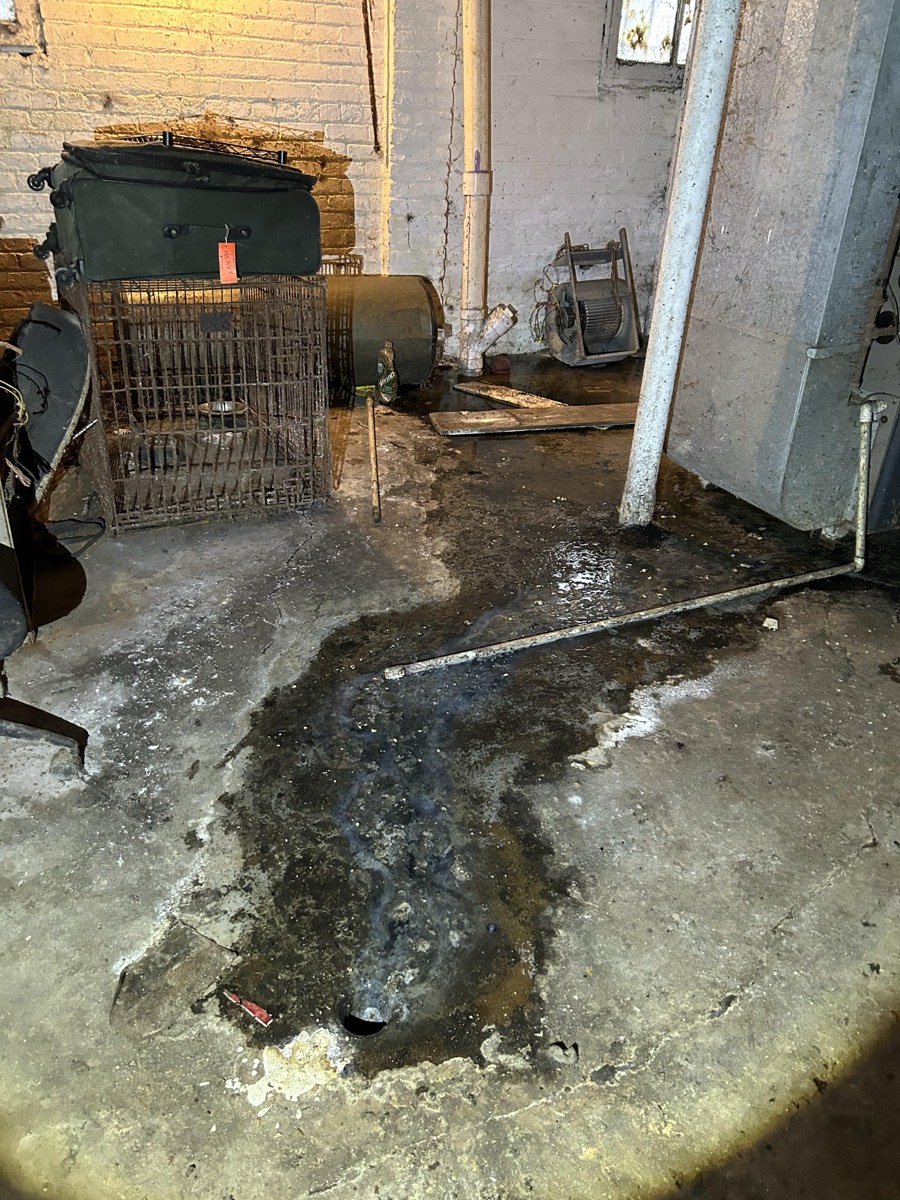
What the contractor was photographing. He posted it asking, publicly, whether anyone knew of a program he could send these families to.
Photo: u/MarcRocket, r/Detroit
“I go to homes with children’s bedrooms in one corner of the basement and feces in the floor in the opposite corner… I’ve called the city, I’ve emailed Rebuilding Detroit and other offices and never got a reply.”
The problem
A basement full of sewage, and a $15,000 quote
Detroiters asked the City to investigate water in their basements 14,115 times between January 2023 and 2026-09-18. DWSD says about one in three private sewer connections is clogged, offset, or has fallen off the City's sewer. When the problem is on the homeowner's side, a repair runs $5,000 to $20,000.
The help is real but scattered: a $184M Alley Sewer Repair Program with no application and no address lookup; a Private Sewer Repair Program worth up to $30,000 whose own guide states two different income limits on different pages; a Critical Home Repair round that closes in days; and the 45-day clock, which is the only one that runs whether or not anyone is paying attention.
In April 2026 an 86-year-old Detroiter was pumping his basement by hand every morning while the City said his sewer was not on its records (WDIV). And the biggest private-line program does not reach everyone: 5,053 of those reports (36%) came from outside its 97 neighborhoods. See the map.
What it does
One address, six segments
Detroit’s money is not organised by what happened to you. It is organised by which part of the pipe broke, and each segment has a different owner, a different symptom and an entirely different funding source. No page anywhere lays them side by side, so that is what the report is.
The segment that matters is the fourth: the connection between your lateral and the main under the alley. Legally it is yours, physically it sits under public ground, and it is what the $184M program repairs for free, if it reaches you.
Two real Detroit addresses, three miles apart, both with a city main on record:
7806 Mettetal St
District 7 · contracted work 213 m away
5017 W Outer Dr
District 2 · no alley in the first round
Same question, opposite answers, and today there is nowhere either household could find that out.
The finding
The first round is not going where the basements flood
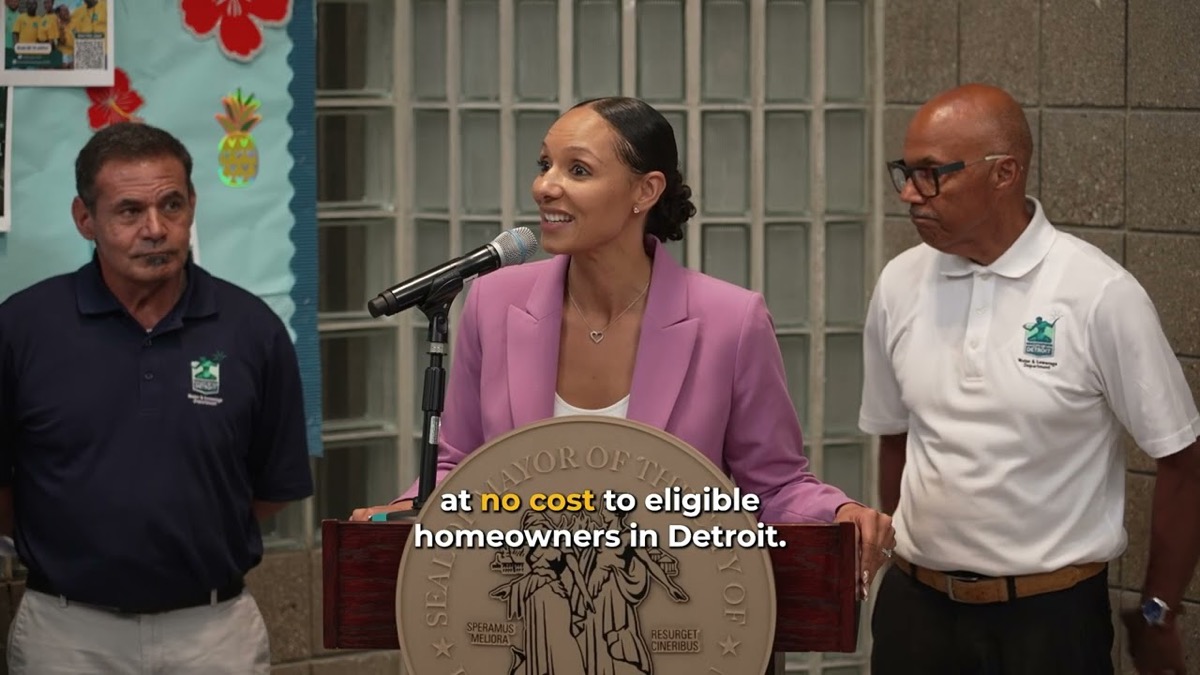
July 2026: the City announces $184M to repair about 9,000 residential sewer connections. Residents cannot apply, and the list of alleys is not published.
Photo: City of Detroit
DWSD publishes its selection criteria but not its list. I queried all 782 feature services on the City’s ArcGIS organization: for sewers, only catch basins and gravity mains are public. The 30,000+ failed-connection data points the City says it holds are in none of them.
So I measured the criteria that do have open data, against the 138 alleys already under contract and the 47 the City completed before this program. Median basement-flooding reports within 500 m: 18 around the chosen alleys, versus 45 around the earlier ones, p < 0.0001. Cave-ins run the other way.
The plain reading is that the first round tracks collapsed pavement, which the City sees in its own asset records, rather than flooded basements, which residents report and which may never become a DWSD record. Four of seven districts have nothing yet, including District 4, which the City’s own Action Plan named a priority. The full method and every caveat.
Two independent comparison groups sit at 38 and 45. The new program sits at 18. Permutation test on the gap: p < 0.0001.
The City’s CDBG-DR Action Plan named Districts 4, 6 and 7 as priorities. District 4 has none.
Why it is still unsolved
Three departments, two logics, one invisible list
The $184M Alley Sewer Repair Program is supply-driven: the City picks, nobody applies, nobody is notified. The Private Sewer Repair Program is demand-driven: you apply, and you must prove the June 2021 flood damaged your home, five years later. They sit in different departments, on different pages, and the City’s own guide states two different income limits for the same program on pages 3 to 4 and page 10.
The cruelest rule is the sequencing one: PSRP cannot pay for work that has already started. Acting sensibly in an emergency disqualifies you from up to $30,000. That is written in the policy, and it is not surfaced at the moment anyone needs it.
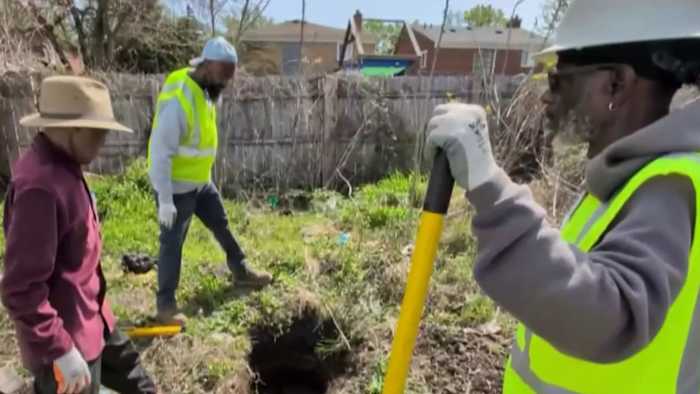
Fifty years of flooding. The couple called the City repeatedly and got nowhere; the City arrived within thirty minutes of a TV crew, and the fix was clearing a manhole and snaking the line.
Photo: WDIV Local 4
“This sewer is not on our records, it’s not on our maps. We don’t know whose sewer it is.”
The city cleared that line within days of the broadcast. I sampled 1,500 flooding reports and asked whether any city sewer main appears within 120 m in the published data: 29% do. For the other 71%, a household looking up its own block finds nothing at all.
Why it repeats
Not a form you fill once
A backup is not a single event. It returns with every heavy storm, the alley programme rolls out over four years in phases nobody publishes, and program rounds open and close. The same household checks again after the next storm, after a neighbour’s alley is dug up, before signing a contract, and before a sale. Each check is a decision worth $15,000 to 30,000.
The people who touch the most households are not homeowners at all, they are the plumbers, waterproofers, block clubs and district staff who stand in these basements weekly. One page that answers “wait or pay” from an address is a tool they can use on every visit.
Impact, if adopted
What actually changes, and for whom
- For the ~11,500 households the City will reach: they stop paying $5,000 to 25,000 for a repair that was already contracted. The City budgets about $20,400 per connection; paying for one privately a month before the contractor arrives is money that never comes back.
- For the ~68,000 it will not: they stop waiting. Years of sewage, mold and falling property value accumulate while a household waits for a notification that is never sent.
- For the City: the same measurement is a public check on a $184M program that has three years and most of its budget still to allocate. Publishing it now is the only moment it can change anything.
- Beyond Detroit: homeowners own their sewer laterals in most American cities, and the same three public datasets, 311 requests, capital project phases, and census income, exist almost everywhere. The selection criteria and the neighborhood rules are configuration; the method travels. What does not travel is Detroit’s particular program mix, which is why I say “City of Detroit only” rather than pretending otherwise.
How it sustains itself
It costs almost nothing to keep running
Every input is public open data, the app runs as static pages with no AI at runtime, and there are no accounts to administer. The honest answer to “how does this make money” is that it does not need to in order to survive , which for a civic tool is a feature.
Where revenue could come from, in order of how much evidence there is: the City’s PSRP policy already contracts community organizations, for a fee, to do outreach and application intake, so a pre-screening tool has a buyer-shaped hole to fill. Nobody has agreed to buy it. I deliberately refuse the obvious one, selling leads to contractors, because the advice “do not pay for this yet” is only worth anything if nobody is paid when you do.
What it refuses to do
Honest by design
- It never draws a guessed pipe. No public record locates a private sewer line; only a camera inspection does.
- It never predicts DWSD’s decision. The deciding evidence, a camera inspection of your connection, is not public, and the report says so on every address. A missing lookup stays unknown, never a no.
- It never writes a cause into your letter. Saying something in writing that later turns out to be wrong is worse than saying you do not know.
- It does not decide eligibility. It shows the rules, including where the City's own documents contradict each other.
What is not proven
Read this before you trust it
The public evidence that this problem exists is strong, and the finding above is checkable by anyone. The evidence that this tool changes an outcome is not: no resident has been observed using it to decide, no agency has agreed to receive anything it produces, and this is the first round of a four-year program that may yet even out. Those are the next things to find out, not things to claim.
Program rules move, and the mailing address for a claim has moved before. Confirm anything you are about to rely on with the department that runs it. Every source is listed, with the date it was checked.
Who built it
One Detroit resident, with AI assistance
Built for the Venture 313 Buildathon 2026, free and open source. The app uses no AI at runtime: every statement comes from public data or a published rule, through code you can read. It is not a utility locate, an inspection, or legal advice.